


Altitude
7246m

Co-ordinates
28°45'38"N, 83°09'20"E

Duration
35 Days

Best Season
Spring and Autumn

Activity
Mountaineering Expedition

Trip Grade
Difficult
Putha Hiunchuli Peak
Towering at 7,246 metres, Putha Hiunchuli, also known as Dhaulagiri VII, is one of Nepal’s most remote 7,000m objectives. Sitting deep in Lower Dolpo in western Nepal, it demands a commitment that most expeditions never ask of you.
The summit is the prize. The full Dhaulagiri massif, the vast wilderness of Dolpo, and the untouched peaks of western Nepal stretch across the horizon in every direction. A view earned through days of walking through terrain most climbers never reach.
Getting there takes ten days on foot through Lower Dolpo, no roads, no shortcuts, no crowds. The route follows a moderately technical snow ridge to the top, testing experience and resolve in equal measure.
For mountaineers ready to step away from the well-known routes and take on something genuinely serious, Putha Hiunchuli is exactly that peak.
Arrive at Tribhuvan International Airport and complete visa formalities on arrival. Our representative meets you at arrivals and transfers you to your hotel in Kathmandu. The rest of the day is free.
All personal and technical gear is checked against high-altitude climbing requirements. The expedition leader briefs the team on the route, acclimatisation schedule, safety procedures, and logistics. Time available for last-minute gear purchases in Thamel.
Morning flight west to Nepalgunj. Transfer to hotel on arrival. Early rest ahead of the onward flight the following morning.
Early morning flight to Jhupal airstrip, the gateway to Lower Dolpo. Short drive to Dunai, the administrative centre of Dolpo district. Overnight in Dunai.
Trek begins along the Bheri River through farmland, pine forest, and Magar and Thakuri villages. The trail gains altitude gradually on well-worn paths. Tarakot is a walled fortress town perched above the river, one of the oldest settlements in Dolpo, positioned on the ancient salt trade route between Tibet and the lowlands. Overnight camping.
Route enters narrow gorges with steep valley walls on both sides. The Barbung River runs below for much of the day. The trail is remote, sees very little traffic outside expedition season, and crosses several wooden bridges over side streams. Overnight camping at Musi Khola.
A stone staircase climbs out of the gorge early in the day. Above it the trail opens onto wider terrain with the first clear views of Putha Hiunchuli, Kangmara, and the Dhaulagiri range. Kagkot is a small stone village at the edge of the high alpine zone. Overnight camping.
Rest day at Kagkot. Short hikes to the surrounding ridges for gradual altitude gain without overexertion. Health checks throughout the day. From the ridges above camp, clear views across the Dolpo plateau and the first sightlines toward the upper mountain.
Trail crosses open yak pastures and wide valleys as the terrain shifts fully into alpine. Panjing is the last permanent settlement before Base Camp, a handful of stone houses at 4,200m where yak herders camp in summer. Overnight camping.
Two high-altitude passes must be crossed today; the first at 4,160m, the second shortly after. The route above Panjing is steep and narrow in sections, with deep ravines on either side. German Base Camp sits in a sheltered hollow named after early German exploratory expeditions in this region. The full south face of Putha Hiunchuli comes into view for the first time. Overnight camping.
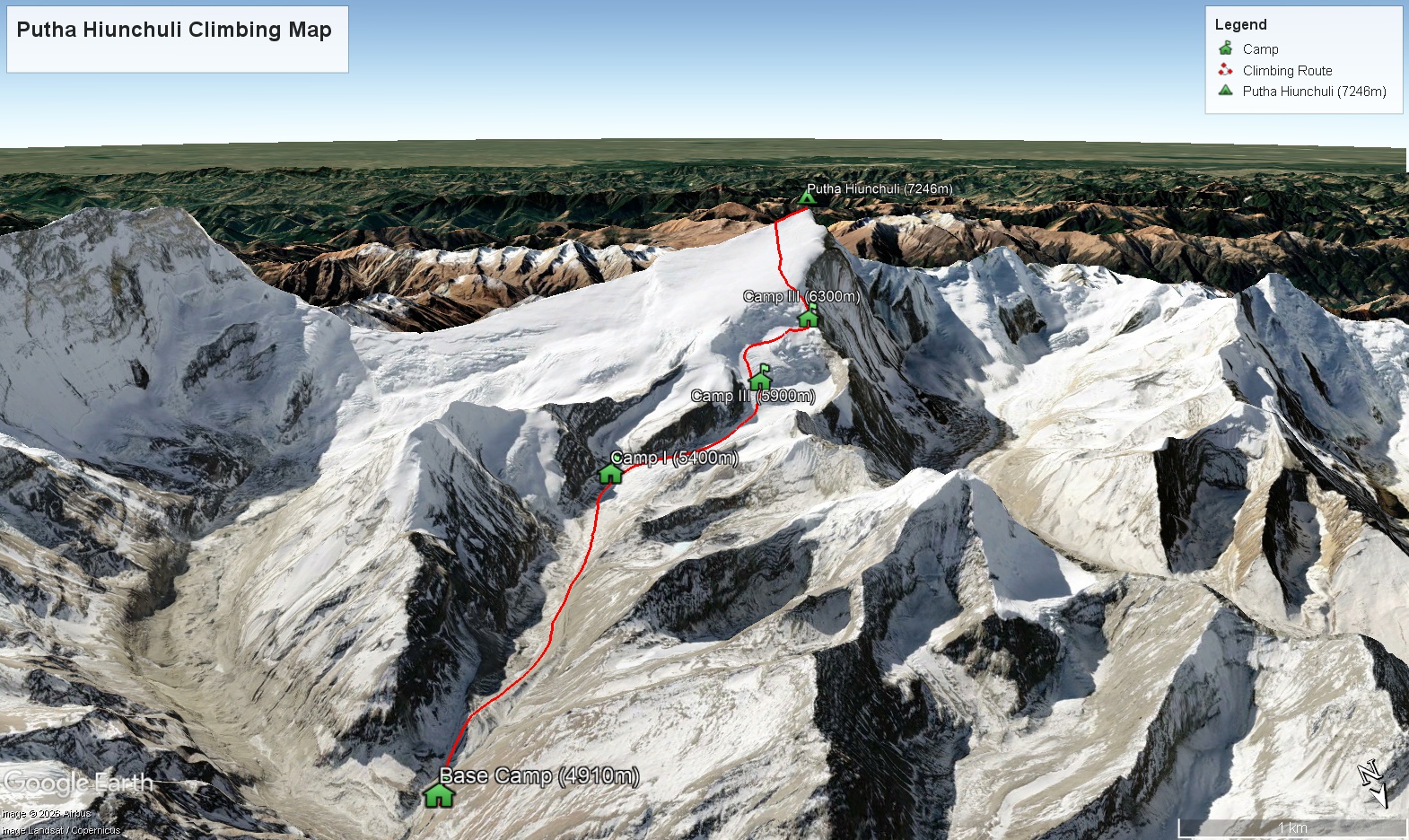
The final push to Base Camp crosses moraine fields and glacial debris. The trail is short in distance but demanding at this altitude, slow, deliberate progress. Base Camp is established at 4,910m directly beneath the Northeast Face. From here the full climbing route is visible: the lower glacier, the three camp lines, and the summit ridge above. Camp setup, equipment organisation, and rest for the remainder of the day.
Rotation 1 (Days 14–17): On day 14, we will climb from Base Camp to Camp I (5,360m). This route crosses the lower glacier and gains the snow ridge to Camp I. Overnight at Camp I. On day 15, climb from Camp I to Camp II (5,940m). Ridge steepens with crevassed sections through the mid-glacier. Fixed ropes on exposed sections. Overnight at Camp II. On day 16, we will touch camp Camp II back to Base Camp. Day 17 will be a rest day at Base Camp.
Rotation 2 (Days 18–23): On day 18, we will again climb from Base Camp to Camp I (5,360m). Overnight at Camp I. Day 19, from Camp I to Camp II (5,940m). Overnight at Camp II. On day 20, Camp II to Camp III (6,475m). Slope angle is 40–50° on the upper approach. Team reaches Camp III, spends 1–2 hours, then descends to Camp II or Base Camp the same day. On Day 21, return to Base Camp if not already there. Days 22–23 will be rest days at Base Camp. Gear check, weather monitoring, and summit window confirmed with the team.
Summit push (Days 24–27 — weather dependent): Day 24: Base Camp to Camp I (5,360m). Overnight at Camp I. Day 25: Camp I to Camp II (5,940m). Overnight at Camp II. Day 26: Camp II to Camp III (6,475m). Overnight at Camp III. Day 27: Depart Camp III at around 4:00 AM. Route follows the Northeast Ridge — steep snow and ice with fixed ropes through the upper sections. The ridge has a false summit before the true top. From the summit at 7,246m, views cover Dhaulagiri II, III, IV, V, and VI to the west, the Annapurna range to the east, and the Dolpo plateau below. Descend to Camp II or Base Camp after summiting.
Base Camp dismantled. Descent on the approach route. Altitude drops by over 1,700m in a single day, and the body responds quickly. Overnight camping at Kagkot.
Continued descent through familiar terrain back to lower altitude and greener ground. Overnight camping.
Final trekking day. Return to Dunai along the Barbung River. Overnight in Dunai.
Drive to Jhupal airstrip, then fly to Nepalgunj and connect to Kathmandu. Transfer to hotel on arrival.
Free day in Kathmandu. Optional sightseeing or shopping in Thamel.
Transfer to Tribhuvan International Airport for your international flight.
Package details
What's Included
- Airport pick-up and drop-off in Kathmandu.
- All domestic flights — Kathmandu–Nepalgunj–Jhupal and return.
- All meals and accommodation during the trek and expedition.
- Putha Hiunchuli climbing permit and Dolpo restricted area permit.
- Experienced Sherpa climbing guide and support staff.
- Guide, cook, and porter wages, insurance, food, and accommodation.
- All group camping equipment (tents, kitchen, ropes, fixed lines).
- Liaison officer fees.
- Garbage management fees.
What's not Included
- Nepal entry visa fee.
- Travel and medical insurance (mandatory, must cover helicopter evacuation above 7,000m).
- Lunch and Dinner During your stay at Kathmandu and Nepalgunj.
- International flights.
- Personal climbing equipment (boots, harness, crampons, ice axe, sleeping bag, down suit).
- Beverage purchases (soft drinks, bottled water, beer, hot drinks).
- Tips for guides, porters, cook, and driver.
- Personal expenses and souvenirs.
Book Now
Our experienced guides and expedition team are ready to plan your Putha Hiunchuli adventure. Fill out the form and we’ll get back to you within 24 hours with a tailored proposal.